Category Archives: Miscellaneous

Is It That Important?

e7887-29635236651_7496b1a7d4_nI propose that for one full year, all newspapers should change their emblems. Even the electronic media could do the same. All of them would have the same emblem — a skull and two bones — the usual representation of death. Let all people wake up in the morning, and before opening themselves to their daily dose of news and analysis come face to face with the skull, be reminded every morning of the inevitability of their end. All is going to end, all are going to end. In the conclusion, all is either ash or dust. Nothing else matters. Continue reading

In Praise Of Laziness

Let's Be Lazy!

I expect the bones of an individual to be stronger and in better condition than the rest of the body constituents. How less effort is involved in vitamin D intake! Just lie down in the sun. You do not have to work out, sweat out, not even make the little effort of eating. Just keep lying there. If anyone tries to agitate you, rebuke you, and interrupt you in your occupation and urges you to do something else that is considered to be more important, you may simply protest — ‘Can’t you see? I am making my bones stronger!’ Continue reading

The Motion Called ‘Life’

349ec-29583537076_1eaa6fceb8_nA man purchased a car, took care of it very well, cleaned it, washed it, kept it covered lest dust should accumulate on it, had built up a garage for it so that any cricket ball or stone from the kids playing in the garden would not damage it. He requested one of his friends having an expert knowledge in vehicle maintenance and hardware to visit him Continue reading

A Real Hero : Pavan Kaushal

d4fb2-28989031902_76936a4eb8_n

Some childhood memories never fade. I was then 4 years old. Every year during Navratri, Ramleela was played in the community ground. Two brothers — Suraj Kaushal and Pavan Kaushal, then about 18 and 16 years of age, used to play the roles of Ram and Laxman every year. Their selection was obvious, because they were very good looking, handsome, of appropriate age (which ensured their presence on stage for another 5-6 years), and of course, because they were real brothers, so had similarity in facial features. They were widely admired and very popular. Continue reading

Are You Also Surfing Too Much?

ddc8c-3175249724_9bf3959280_nWalking through corridors of computer centre and various laboratories, I occasionally witness students and young workers completely glued to the screens, switching the tabs between YouTube and Facebook. It is not that elders and seniors do not act in a similar way. My concern is the draining out of precious efficiency, strength and creativity of youth years. Sri Harishankar Parsai called it the age to make mistakes and learn from them. There is something hypnotising in these services, which makes it near-impossible for the young to retract their steps. It does lower the conscious level, makes the mind dull and stupid, not to mention the number of hours wasted that way. Continue reading

My Dear Angel (two closed couplets)

6c6d6-4115126397_4da2ecbc1c_n

Two closed couplets to remember the angels in our lives. Most of the time, we struggle alone in life, we fight alone, understanding that all the required strength and ability lie within us. But somehow, there is a doubt — in ourselves, in our own capacity. Then someone comes who stands by our side, shows trust and faith in us, and provides the support and confidence we require to move ahead. Without that angel, it is doubtful whether we would have even taken the first step or not. It is not something of a physical or financial nature, or of resources. Most of the time it is just simple words Continue reading

What is in Name? A Lot!


— Did I keep you waiting for long?
— No, not much. We too came just a while ago.
— Ordered?
— No, not yet. We were waiting for you to come. What would you like to have? Tea, coffee, cold drink?
— Tea.
— Any special one? Special, less sugar, more sugar, black tea, ginger tea, lemon tea…
— Stop stop. Nothing of that sort. Just ordinary, plain tea.
— Anything with it? Samosa, pakoda…
— Stop it man! Just go and order whatever you want to eat. I would take only tea.
— OK fine. As you wish. Chhotoo!
— Is that his name?
— No, just like that.
— Then?
— How could I know?
— Did you ask?
— Who cares!
 
How many people take for granted the name of the person who comes to clean their offices, or the postman, the milkman, tea man, canteen fellow, shopkeeper. Have you yourself ever been curious? It is strange that people hardwire to their brains the names of all cricketers, footballers — not from their own country but also from others, of movie stars — people whom one never meets, has no chance of meeting either, and it does not make any difference if one meets or not. But one doesn’t show the same enthusiasm to discover or simply query the name of the person whom one meets every day — on a routine basis. Simply because they are not important? But aren’t they?
 
It is not the same as the innumerable ways people call their little ones — king, queen, prince, princess, angel, fairy, pearl, diamond, bird. Also not the same as the nickname they put for them, sometimes a shortened form of their formal names, sometimes an entirely different name; or the ones that their classmates and friends choose for them — naughty, diminutive, stupid, and affectionate. But here, there is neither any affection, nor a circumvention for comparatively longer and complicated names. Here, it is complete apathy, lack of concern for the people whom one considers ‘less important’, their identity, in fact their existence in our world. It would not be practical to keep querying the names and remembering all of them of all the people one encounters in the journey through life — people whom one meets in buses, trains, trips, other places and cities. Instead, we are talking here about the people one meets daily, on a routine basis, who mean so much for our comfort, if not for survival, yet are taken for granted.
 
Then there are so many of us who can’t even take the smallest trouble to spell correctly (in writing) others’ names. Isn’t it simply an utter contempt and disregard towards the other person? All our big words of admiration and respect do not sound honest then. It hardly takes less than a minute to carefully observe the person’s name in its correct form and to commit it to memory. Even for few complicated words, especially from other cultures, one can invent formulae and mnemonics (without telling the person, of course).
 
Surely it all depends on whether and how much respect one wants to give the other person. If the answer is in negative, then what is the point in starting with the communication and connection at all? Let us not forget that the sweetest sounding word for any individual from any country and culture and speaking any language is not the name of God, instead it is one’s own name.
 
Now, here is something to cheer you up:
 
— Such a sweet child! What is your name, little one?
— Monu.
— No, no, not that. The school name.
— Bal Bharti Public School.


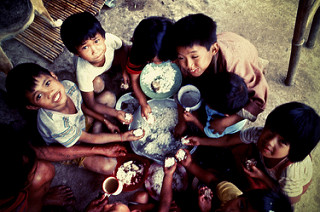
photo credit: Sobrinos via photopin (license)

A Colourful World

This is a complex world. Multicoloured. To present it only in the shades of black and white is wrong. If you do, you are bound to miss many different shades. And it would be a great loss. Indeed.

Everyday we see, hear, read about people getting rude and abusive to others. At the same time, there are thousands of others who pass on a friendly smile to strangers, let the other vehicle pass, give a lift to young students, move a little aside so that another passenger could be accommodated, help somebody place his luggage on the upper berth. These people are never counted, not recognised, you would not find any report on them in any newspaper. Yet they exist.

A national daily reported a very kind and noble gesture by the residents of a colony. Every day one of the residents on turn would give the traffic policeman on the nearby crossing a bottle of cold drink. Now did you know about this?
 

In a lecture Prof. Rajmohan Gandhi said in the context of the partition of India that — ‘It is well known that many people were killed, many people were looted, many people lost their homes. However, what is not well known, and is not reported, is that there were a far greater number of people who saved lives, who extended help and relief, who provided shelter’.
 

Good and bad both exist in the world. Had the positive forces not been there, the world would have already collapsed a long time ago. It is the power and strength of the good that has helped to maintain the equilibrium, and kept the balance from shifting in favour of the bad. Then why is it not visible, why can’t we see it more often? Perhaps because the good is always modest. It does not shout. It works silently and makes no claim. It is up to you to recognise it whenever you meet it next. And don’t forget to say thanks.

photo credit: 777ps_01768.jpg via photopin (license)

Lessons (short story)


A short story in two parts.

PART I

A class is in progress, the teacher is scribbling on the blackboard, and the students concentrating on her writings and trying to absorb the matter.

— So, if we draw a triangle like this, and denote the base by ‘b’ and perpendicular by ‘p’, and this angle by ‘theta’, then the ratio of ‘p’ to ‘b’ would be equal to tangent of theta, and denoted by tan(theta) –
— Excuse me, madam! – one student raised his hand and called out.
— Yes, Rahul. You want to ask something?
— Madam, what are we doing here?
— What is this? Trigonometry, of course! What happened, have you been sleeping or what? Yesterday we learnt about sine and cosine, and today we are reading about tangent. You should be attentive in the class. – the teacher was visibly annoyed.
— No madam, not that. I want to ask why are we studying all this? What is the use of learning all these ratios and all?
— Now, can anyone of you please explain the application and use of trigonometry to this dumb-head? -The teacher addressed the class while on the verge of losing her patience.
A ‘good’ boy, who was perhaps the topper in the class, at least in the subject, raised his hand.
— Yes, Vivek, go ahead.
— Madam, these relationships can be used if someone wants to measure the height of very tall objects and structures like a building or a tree. These are also helpful in measuring otherwise inaccessible geographical features like mountains. – the good boy explained in a confident voice and with a straight face.
— Very good. Sit down. And you, understood? – she turned to Rahul and asked sternly.
— Yes madam, I know that. But I am asking why would anyone want to do that? I mean, the mountain or the tree is there. Why would a person need to measure its height? – asked Rahul, still not convinced.
— Shut up, and sit down!

PART II

— You must not give up so easily. The whole family is dependent on you. If you break down, who would support them?
— But why? Why had it to happen to us?
— One never knows, my friend. Such things happen all of a sudden, we are never prepared.
— He took such an extreme step! Not for a moment thought of us, his sister, his mother whom he loved so much, of me?
— It only shows how great his sorrow must have been. Must be unbearable. Even his love for you all could not stop him.
— But why didn’t he call us up? At least he could have let us know.
— He must have. Could be that he hesitated a bit, thought that you would understand his trouble from his voice. Or may be he waited for you to ask. Maybe you could not understand or sense it. I do not blame you. But it could be that. Signs of such troubles are seldom visible on the surface.
— Maybe. Maybe I have been rude to him or perhaps indifferent. Maybe he felt barrier between us. But he has friends, and his sister with whom he used to gossip all day and night, his cousins who are all grown up and could have helped. Then his old teachers, and new present ones too. He could have approached anyone. If not me, fine. But anybody –
— That is the saddest part. In spite of all this crowd, he could not find a single person he could relate to. Just imagine. He is afterall just a child.
— Even then, some other alternative. Anything other than this horrible thing to do. He could have explored, thought of some other way out, anything other than just going ahead and ending everything like this.
— Now, now, you are thinking and speaking like a 50 years old man; do not forget that he is…was…just 21. He was still a child for us, just a child. He could not have thought like you. Yes, you are right. There must have been several other better alternatives than this terrible solution. But how could he know? He didn’t even know how to think. Or what to think. And where to look for solutions. He did not know, he was never taught…

FINIS

Footnote: Part-I of this narrative is based on a scene from a Doordarshan serial; however, their focus was different from this work. I do not remember the name of that serial or the title of the episode; only that it concerned itself with the country’s education policy and needed reforms. Ms. Himani Shivpuri acted in it. Part-II is fictional; nevertheless, the readers could relate it to any incident they might have read, heard, or witnessed.

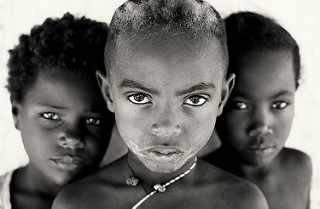
photo credit: Madagascar, young children via photopin (license)

What do you say Sir?

A scene from a popular Hindi movie shows a big crowd assembled before a building and looking upwards in the direction of a top floor where some action is presumably taking place. The protagonist arrives at the scene, and asks a bystander what is going on. The man answers simply, “I do not know. Everybody is looking in that direction, so I am also looking that way”.
The primary aim in formulating education policy and bringing about changes in the present education system is purported to help the people of the nation provide for themselves and their family, and live a life of dignity in a healthy way. If some intellectuals grow out of such educated class who provide valuable guidance and leadership to the thought process of the nation, then it is an added bonus. Nevertheless, the basic minimum output that education aims at is to bring out good citizens who are able to judge what is best for them and for the society, and thus participate in the democratic governance of the country. Print and electronic media provide the information and expert opinion on the current affairs at regional, national, and global level, thus aiding the individual in possessing a sound awareness of the events around himself, and assess their implications on his immediate surroundings.

But are these aims fulfilled? Much has been said about the flaws and limitations of education system of the country, and several suggestions have been proposed to improve or change it. However, in spite of these limitations, at least some output in terms of the aims mentioned previously could be expected. Are we able to see it? Is the society taking decisions based on an analysis of the information provided and an educated opinion, or is it just looking in a particular direction only because everybody is looking that way?

I am not alluding to any particular issue or event or person. But look around yourself and you may see it happening all the time. People vote for a particular leader or a political party because everybody says it is going to win, we go to watch blockbusters, we read bestsellers, and we go for hot tourist destinations. We assume that since everybody is going a particular way, there must be something worthwhile on that path. It is definitely not to say that that leader, political party, movie, book, or tourist spot does not deserve the fan following it commands. Also, this does not imply that the individual should always strive to take a position contrary to the majority opinion. Instead, simply that in several cases, a person’s support and admiration is not based on personal opinion and judgement.

“What should we order for you?”
“Whatever. Anything that you people prefer.”

Can you relate to this conversation at any restaurant? The way we lead our personal, professional and social lives is not very different. We tend to bypass decision-making.

There is a fear that if everybody starts thinking and speaking one’s mind out, there would be utter chaos, and very little, if any, fruitful progress would be made in any direction. But isn’t this what democracy is all about? Of course, a synthesis of all the possible opinions is seldom feasible. Several compromises need to be made, and mostly the majority has its way. Perhaps we cannot help it, and can only try our best to accommodate all points of views to the maximum degree possible. The streamline flow is an ideal situation where everybody has the same point of view — something that we see during wars and sports, for example. Otherwise, it remains only an ideal rarely witnessed, but one worth looking forward to. Still, even if we ever do manage to achieve it, we should take care that it is because each individual shares the common opinion, and not because everyone else seems to look in a particular direction.

Here we are talking about a very simple occurrence that takes place several times a day in our lives — something that lasts just a few seconds, and involves taking a very simple decision, provide our opinion, or solicits some action on our part. In simple terms, it requests us to stand up so that people can identify us out of the crowd, and provide our valuable individual contribution. Providing education is a big investment, and involves a lot of effort on part of the government and other societies involved in it, and also the employees working at different levels. Everyone needs to show that all that investment and effort was worth it, and each penny was well-spent. Society moves in a stream; however, every droplet counts.

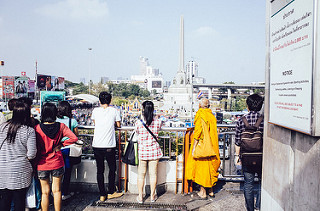
photo credit: Observing protests near Victory Monument, Bangkok via photopin (license)