
Today is the birth anniversary of Sri Ramakrishna Paramhamsa (18 February 1836 — 16 August 1886). Although I had heard about him since my childhood, I didn’t know much about him. I always thought him to be similar to several other saints and divine personalities that this land has produced. I became more and more interested in him after reading Swami Vivekananda literature, who used to refer to his Master time and again. I got one small book containing compilation of quotes by Sri Ramakrishna, and was immediately touched and moved by the utter simplicity of his words and thoughts. It is remarkable to even think that such complex ideas of Indian philosophy and spirituality could be explained and elaborated in such simple words.
Continue reading
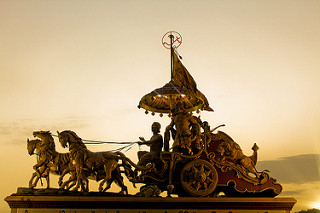 It is said that a classic is a book which has never finished saying what it has to say. Admirers and followers of the Gita say the same thing, i.e., even after years of study and analysis, every time someone reads the scripture, new meanings and messages come out of it. It is always fresh, always new. I do not oppose this assertion, and my only concern has always been that Indians have always considered Gita as a symbol or a label, to take oath in courts, as a token to prove their religious nature, truthfulness, attachment to duty and so on. Very few people ever take the trouble to open it and see what actually is written on those pages. Treatment of Gita is no different from that of Swami Vivekananda — the moment children or youth open their messages, their parents become afraid that they are going to become monks! And of course, parents’ own desires and ambitions are attached to the children, so why would they allow that to happen?

 Pradyot