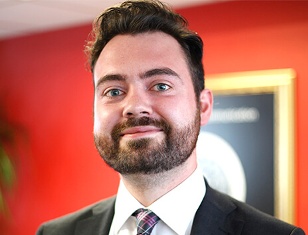
Keith Broni, photo source: Today Translations.
I had been in regular correspondence with her for quite some time without any communication gap. Her English was flawless without any grammatical or punctuation errors, a virtue which I always admire. However, one day there was an unusual error — she ended the sentence with a colon and closed it with a parenthesis. As I could not locate the opening bracket, I concluded that she had deleted a part of the sentence by mistake. Continue reading
 I am writing to you after a long gap. A sudden unanticipated inflow of work kept me occupied for the last two weeks. Such unexpected change in work schedule is part of scientific research. The work is not yet finished, but now I am getting used to the extra work. It also means that a lot of routine work has piled up — cleaning, organizing, refreshing social contacts, and yes, getting updated with what is going on in the world. So I sat down and browsed through the large pile of newspapers looking for anything interesting that I might have missed.
 I consider myself fortunate to be born and brought up in the yoga capital of the world — Rishikesh, U.P., now in Uttarakhand — and having spent first 26 years of my life at that beautiful place. In fact, whatever you see in me, whether good or bad, belongs to Rishikesh. Of course, Ahmedabad and Kanpur did provide their valuable contribution in providing further knowledge and experiences, and also honed up my skills. For example, though I had been playing harmonica, performing yoga and making paintings ever since my childhood, it was only in Ahmedabad that I took formal lessons in harmonica, joined yoga classes (ironically!), learnt Bengali and Gujarati from my colleagues and started learning Russian. Living in Ahmedabad was the first time I had lived outside the Hindi culture. At Kanpur, I learnt German and French. However, it was only in Rishikesh that the initial impetus was provided and the spark to pursue lifelong learning was ignited.
  From email to social media to WhatsApp, technology-driven social communication has come a long way and that too in less than three decades. And it is further bound to grow and transform itself. Not only there is transformation in this mode of communication itself, but the basic characteristics of human relationship and communication has also changed.
  Every time I go to the book store, my eyes fall on one particular book. I don’t know what that book is about as I have never opened it. However, I like the title of that book, which probably summarizes its message — Don’t Say Yes, When You Want To Say No (by Herbert Fensterheim and Jean Baer). That is a very strong and direct message, and mostly that is the advice most of us require most of the time. In fact, I would say that most of the miseries in our lives are due to the inability to say ‘no‘, though that is the answer we would like to give.
 When at home, I used to lie on the terrace at night and look at the stars, plenty of stars. Light breeze from all directions stroked my cheeks, played with my hair. Oh! What a wonderful feeling! . . . a sense of expanse, no barriers, no constraints.
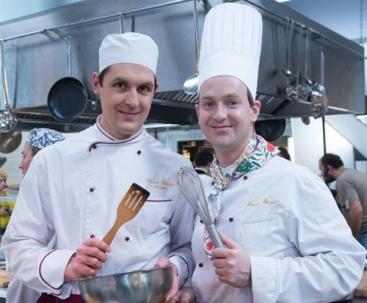
 Pradyot